
Best Greyhound Betting Sites – Bet on Greyhounds in 2026
 Available in US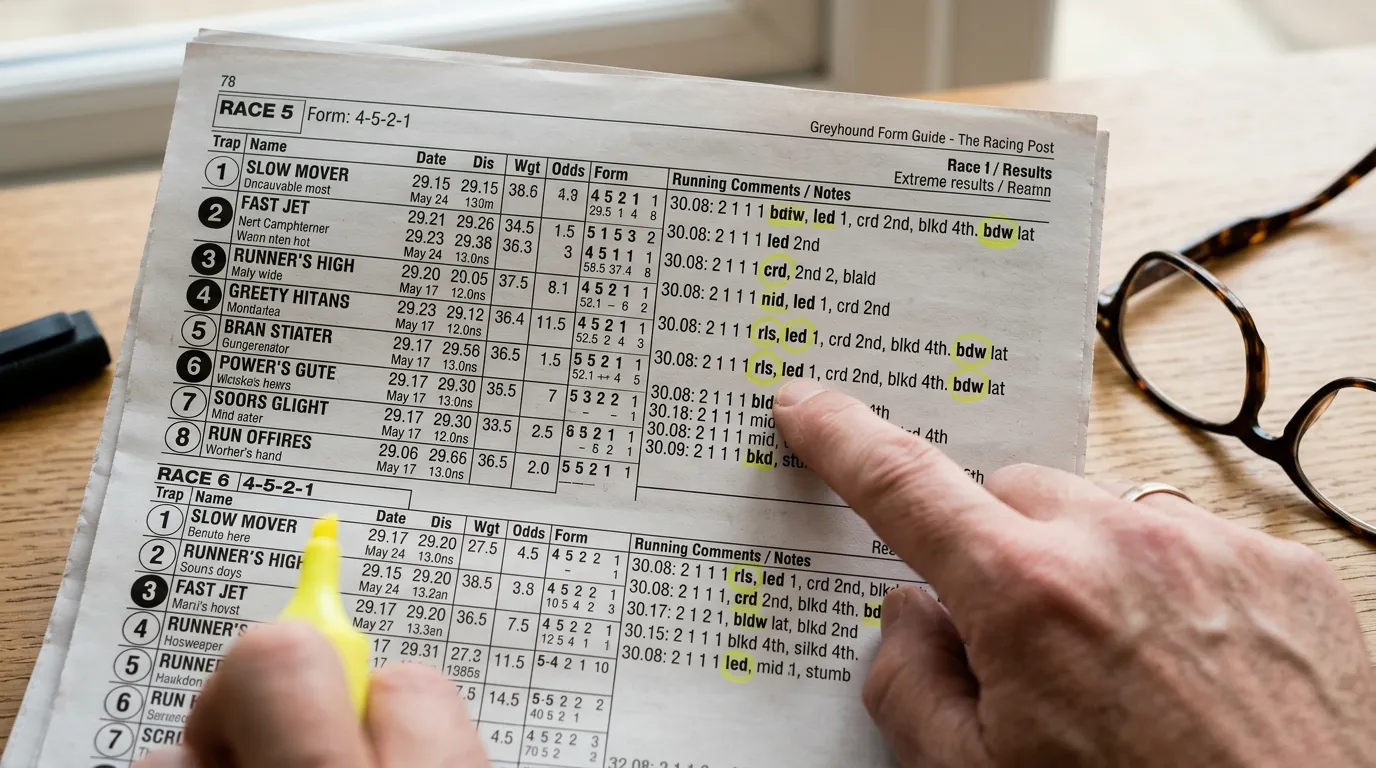
Greyhound form guides speak their own language. Abbreviations, shorthand, and specialist terms compress complex race information into cramped race card space. For newcomers, this jargon creates a barrier—essential information hides behind unfamiliar codes that regulars read instantly but beginners find impenetrable.
Speak the language and form guides unlock. What looks like gibberish becomes detailed race narrative: where dogs ran, what trouble they encountered, how they finished relative to expectations. This glossary decodes the standard terminology, translating industry shorthand into plain English. Master these terms and you’ll read form guides as fluently as the professionals whose livelihoods depend on extracting every available piece of information.
Race Card Abbreviations
Race cards pack maximum information into minimum space. Standard GBGB abbreviations appear across all licensed tracks, creating a unified system that works whether you’re studying Romford or any other UK venue.
Position figures dominate race cards. Numbers 1-6 indicate finishing position in previous races, with 1 representing a win and 6 representing last place in a full field. Letters supplement these numbers: W indicates a win (sometimes used alongside 1), F indicates a fall during the race, and O indicates the dog ran outside the placings without specific position noted.
Distance codes appear constantly. The abbreviation “m” follows numbers to indicate metres—400m, 575m, and so on. Some cards use “y” for yards at tracks that haven’t fully converted to metric. When comparing form across distances, recognise that 400m roughly equals 437 yards, though exact conversions vary slightly between tracks.
Grade abbreviations tell you the competition level. A1 through to lower letters and numbers indicate graded races, with A1 representing the highest standard. OR stands for Open Race—a race without grade restrictions that often attracts top dogs. Hp indicates a handicap race where dogs receive staggered starts based on ability. M indicates maiden—a race for dogs yet to win.
Trap numbers appear in parentheses or boxes, showing which starting position the dog occupied. T1 through T6 correspond to the six traps, coloured red, blue, white, black, orange, and black-and-white stripes respectively. Seeing form like “2(T4)” means the dog finished second from trap four.
Time notations record performance in seconds and hundredths. A time of 23.45 means twenty-three and forty-five hundredths seconds. Comparing times requires context—track conditions, class of race, and whether the dog led or ran wide all affect raw numbers. Fast times on slow nights mean more than moderate times on fast surfaces.
Trainer abbreviations identify who prepares each runner. Regular punters recognise local trainer codes instantly, knowing whose dogs to watch and whose to avoid. Trainer form—win rates, track records, kennel patterns—often proves as relevant as individual dog form.
Weight figures show the dog’s racing weight, typically in pounds or kilograms. Weight changes between races can indicate condition shifts—significant gain or loss sometimes signals issues worth noting. Consistent weight suggests stable preparation.
Running Comment Terminology
Running comments describe how each race unfolded, using standardised terms that pack detailed information into brief phrases. These comments often prove more valuable than finishing positions alone—they explain why results happened.
Led or Ld indicates the dog led at some stage, sometimes throughout. “Led to line” means they led wire to wire—complete dominance. “Led early” suggests they relinquished the advantage. “Led narrowly” indicates a contested lead. Leadership comments matter because front-running dogs often need clear leads to perform; knowing whether they achieved that reveals whether the result reflects true ability.
Crd means crowded—the dog experienced interference from surrounding runners. “Crd 1st” indicates crowding at the first bend, “crd rn-in” means trouble in the run-in. Crowding often explains underperformance; a dog that finished fourth after being crowded throughout might have won with a clear run.
Bmp indicates bumped—physical contact with another runner. Similar to crowding but typically more severe. “Bmp & fell” describes contact that caused a fall. Multiple bump references suggest a trouble-prone runner or simply bad luck in a particular race.
Chl means challenged—the dog mounted a challenge for the lead or places. “Chl 2nd” indicates challenging while running second. Challenge comments suggest dogs with competitive instinct who engage with rivals rather than merely completing the race.
Wnrd stands for wide-running—the dog covered extra ground by racing wide of the rail. Wide running wastes energy and adds distance; dogs that finish well despite running wide might have won with better racing luck. Consistent wide-running sometimes indicates steering issues or running style that suits larger circuits.
Rls indicates rails—the dog ran along the inside rail, saving ground on bends. Rail-running represents efficient racing; dogs that consistently find the rail often outperform their raw speed. “Rls to 3rd” means they held the rail to third place.
Nvr indicates never—usually “nvr dngs” meaning never dangerous, a dog that was out of contention throughout. Similarly, “nvr trbd” means never troubled the leaders. These comments identify dogs that underperformed regardless of excuse; multiple such references suggest limited ability at this level.
Fnshd or fin describes finishing effort. “Fnshd well” means the dog was gaining at the line; “fnshd tired” indicates fading late. Finishing comments reveal stamina and determination—dogs that consistently finish well might prefer longer distances.
Track Position Language
Where dogs race relative to the rail affects performance significantly. Position terminology describes this crucial aspect of race running.
Mid or M-Tk indicates mid-track—racing neither on the rail nor wide. Mid-track running is neutral, covering more ground than rail-running but less than running wide. Some dogs prefer this position, avoiding traffic while staying competitive.
Wide or Wd indicates running away from the rail, particularly through bends. At Romford’s compact 350m circuit with its tight bends, running wide costs more ground than at larger tracks. Wide-runners need compensating speed to remain competitive.
Saw 1st or Saw 2nd indicates the dog swung wide at the first or second bend. This might describe deliberate positioning or interference forcing them off-line. Knowing which helps interpret the performance.
In or Ins indicates inside running, typically along or near the rail. Inside position saves ground but can trap dogs behind slower runners. “Ins no rm” means inside with no room—blocked without space to challenge.
Clrd indicates cleared—usually “clrd 2nd” meaning the dog cleared around the second bend without interference. Clearing bends cleanly allows dogs to race their natural rhythm rather than checking or adjusting for traffic.
Applying the Glossary
Terminology mastery serves practical purposes—faster form reading, better race understanding, more informed betting. The goal isn’t memorisation for its own sake but fluent interpretation that reveals betting angles.
Pattern recognition emerges from terminology familiarity. A dog whose form comments consistently include “crd” or “bmp” either runs poorly or suffers repeated bad luck. Distinguishing between these requires looking at trap draws, competition quality, and whether the dog creates their own trouble or merely encounters it. Repeated excuses eventually stop being excuses.
Comparative analysis uses terminology to match like with like. A dog whose best run came “rls ld all” from trap one might reproduce that only from inside draws. A dog that “wnrd & chl” from trap six might suit wide draws where they can avoid early traffic. Understanding what the terminology means lets you predict when conditions suit specific dogs.
Form translation works best when you convert terminology into narratives. Instead of seeing “3-2-1 crd & chl 2nd ld clse home” as code, read it as story: this dog placed third, then second, then won after being crowded, challenging into second, then leading close to home. That narrative suggests a dog in improving form who handles adversity and finishes strongly—useful information condensed into a few abbreviated phrases.
The more races you read using this terminology, the more automatic interpretation becomes. Eventually you’ll scan form guides at speed, extracting relevant information without conscious translation. That fluency is the practical payoff—terminology as tool rather than obstacle, unlocking the information that separates informed punters from those still struggling to decode the basics.
Greyhound Form Guide Terms — More on this topic at romford greyhound results.
See also BAGS Racing Explained.
