Best Greyhound Betting Sites – Bet on Greyhounds in 2026
Loading...
Greyhound racing offers betting options beyond simply picking the winner. Each bet type serves a different purpose, matching different levels of confidence, different race reads, and different appetite for risk versus reward. Knowing what’s available—and when each option makes sense—turns betting from guesswork into structured decision-making.
Match your bet to your edge. That principle guides everything that follows. A strong view on the winner calls for one approach; uncertainty about which dog wins but confidence about which dogs will place calls for another. Understanding the mechanics of each bet type means you can deploy your insight through the right vehicle. What follows covers the full range of greyhound betting options from straightforward to complex.
Win and Place Bets
Win betting represents the simplest form: back a dog, collect if it wins, lose if it doesn’t. The odds reflect the dog’s perceived chance of winning, with favourites offering shorter returns and outsiders paying more when successful. Win betting suits situations where you have strong conviction about a specific dog finishing first.
The mathematics are straightforward. A £10 win bet at odds of 3/1 returns £40 if successful (£30 profit plus your £10 stake back). Odds of 1/2 return £15 (£5 profit plus stake). Decimal odds multiply directly: £10 at 4.00 returns £40 total. Win bets either pay in full or pay nothing—no partial success exists.
Place betting lowers the bar for success. Instead of requiring your selection to win, place bets pay if the dog finishes in the places—typically first or second in greyhound racing, though terms can vary by bookmaker and race type. Place odds run shorter than win odds, reflecting the greater probability of success.
Standard place terms for greyhound races pay one-quarter of the win odds for dogs finishing second. A dog at 8/1 for the win might be available at 2/1 for a place (one-quarter of 8/1). Some bookmakers offer enhanced place terms for competitive races—one-third odds or places paid to third—but standard six-runner greyhound races typically pay first and second only.
Place betting suits dogs you expect to run well without confidence they’ll beat every rival. A consistent dog that always finishes in the first three but rarely wins outright might offer place value. The reduced odds compensate for the higher probability of collection, but over time, value exists where dogs place more often than their place odds imply.
Forecasts and Tricasts
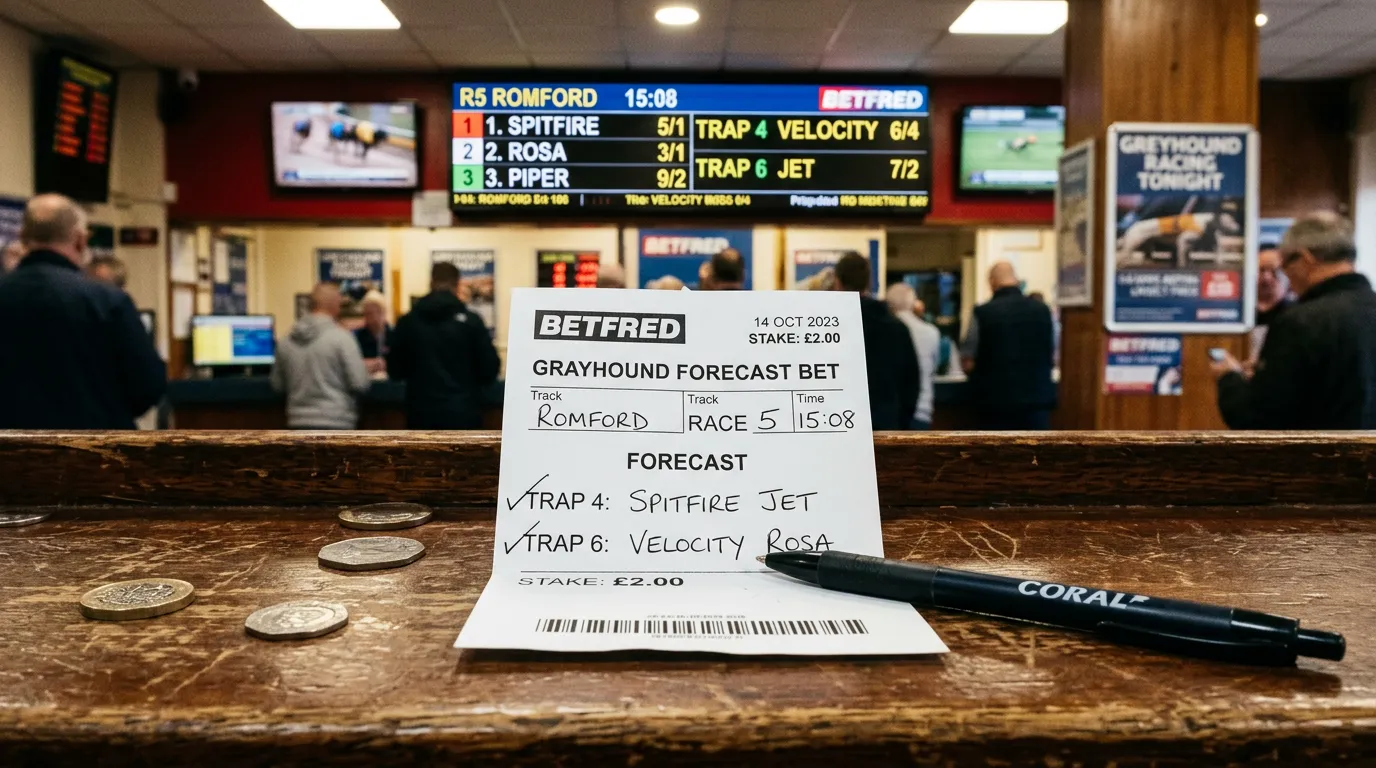
Forecast betting requires predicting which dogs finish first and second in the correct order. This steps up difficulty considerably but increases potential returns. A straight forecast names one dog for first, another for second, both must oblige exactly as specified.
Reverse forecasts cover both possible orderings of your two selections. If you fancy Dog A and Dog B but can’t separate them, the reverse forecast pays if either finishes first with the other second. This costs twice the unit stake since you’re effectively placing two straight forecasts, but removes the need to predict the exact order.
Combination forecasts expand further. Naming three or more dogs and covering all possible first-second combinations creates multiple bets. Three dogs generate six combinations; four dogs generate twelve. Each combination costs one unit, so a £1 three-dog combination forecast costs £6. If any two of your selections finish first and second in either order, you collect on the relevant combination.
Tricasts extend the principle to first, second, and third. Predicting the exact finishing order of three dogs offers substantial returns but demands precision. Straight tricasts require all three positions correctly; reverse tricasts cover all six possible orderings of three dogs. Combination tricasts work similarly to combination forecasts, covering multiple selections across the three places.
Forecast and tricast returns are calculated using a computer straight forecast formula based on the starting prices of the placed dogs, not fixed at bet placement. This creates variance—the same correct prediction returns different amounts depending on how the betting market priced the participants. Backing outsiders into the forecast positions generates larger returns than correctly predicting favourites to fill the places.
These bet types suit races where you have views about multiple dogs rather than conviction about a single winner. Competitive races where several dogs might place—but you’re unsure which will win—become natural forecast candidates. The enhanced returns compensate for the difficulty of predicting multiple positions correctly.
Each-Way Betting
Each-way betting combines a win bet and a place bet on the same selection. The bet costs twice the quoted stake since it comprises two separate wagers. If your dog wins, both bets pay: full win odds on the win portion, place odds on the place portion. If your dog places without winning, the win bet loses but the place bet collects.
The maths requires care. A £5 each-way bet at 10/1 with standard quarter-odds places costs £10 total (£5 win, £5 place). If the dog wins, you receive £55 win portion (£50 profit plus £5 stake) plus £17.50 place portion (£12.50 profit at 2.5/1 plus £5 stake), totalling £72.50 return. If the dog finishes second, you lose the £5 win bet but collect the £17.50 place return, netting £7.50 profit overall.
Each-way value depends heavily on the relationship between win and place probabilities. A dog at 10/1 might have roughly 9% win probability. If their place probability exceeds 36% (four times the win probability), the place portion offers value even when the win portion doesn’t. Each-way betting isolates these situations, allowing you to profit from place certainty while taking a shot at the win.
The trap with each-way betting lies in backing short-priced favourites. A dog at 2/1 each-way costs double the stake for modest place returns (one-quarter odds being 1/2). If this dog loses, you’ve wagered twice the amount you would have risked on a straight win bet. Each-way suits longer-priced dogs where the place portion offers genuine insurance rather than token returns.
Race selection matters for each-way betting. Competitive races with unclear winners but identifiable place contenders represent ideal each-way targets. Races with short-priced favourites likely to dominate make place returns harder to collect; the favourite wins, leaving just one place position for everything else. Open races with multiple chances suit the each-way approach better.
Matching Your Bet to the Race
Different races call for different bet types. The skill lies in recognising which approach suits each situation and deploying your stake accordingly.
Win bets suit races where you’ve identified a clear favourite that the market underrates. If you believe a dog at 3/1 should be 2/1, win only captures that value directly. Win bets also suit short-priced selections where place returns would be minimal anyway. When backing odds-on favourites, the win portion dominates; adding place insurance at tiny odds wastes stake money.
Place and each-way bets suit selections at longer odds in competitive races. The UK favourite win rate of around 35.67% means favourites lose most races. In open contests without dominant runners, place betting on each-way outsiders captures value from the competitive nature of the race without requiring precise winner identification.
Forecasts suit races where you can eliminate runners more confidently than you can identify the winner. If you’re certain two dogs will finish first and second but can’t separate them, a reverse forecast captures that view. Tricky races where form points to multiple contenders become forecast opportunities—your job shifts from picking one winner to identifying the likely placers and covering their combinations.
Tricasts suit large-field events and races with clear layers of ability. When three or four dogs stand out from the rest but their order remains unclear, combination tricasts spread your stake across the permutations. The enhanced returns from tricast payouts compensate for the difficulty of predicting exact order.
Stakes should reflect confidence. Maximum bets belong on strong views backed by evidence; minimum bets suit speculative shots. Different bet types allow different stake calibrations within the same race—perhaps a win bet on your selection plus a saver forecast excluding the clear favourite. The range of available bets means your betting can express precisely the level and nature of your conviction.