
Best Greyhound Betting Sites – Bet on Greyhounds in 2026
Loading...
UK greyhound tracks are not interchangeable. Each venue has its own circuit size, bend tightness, run-up distance, and surface characteristics that affect how races unfold. Dogs that excel at one track might struggle at another where the geometry demands different attributes. Understanding these differences helps punters interpret form accurately and identify when dogs face familiar or unfamiliar challenges.
Know your venues—that principle guides track comparison. A dog transferring from Romford to a larger circuit faces different demands than one making the reverse journey. This guide maps the licensed track landscape, positions Romford within it, and explains how to use track knowledge when assessing form from different venues.
The Licensed Track Landscape
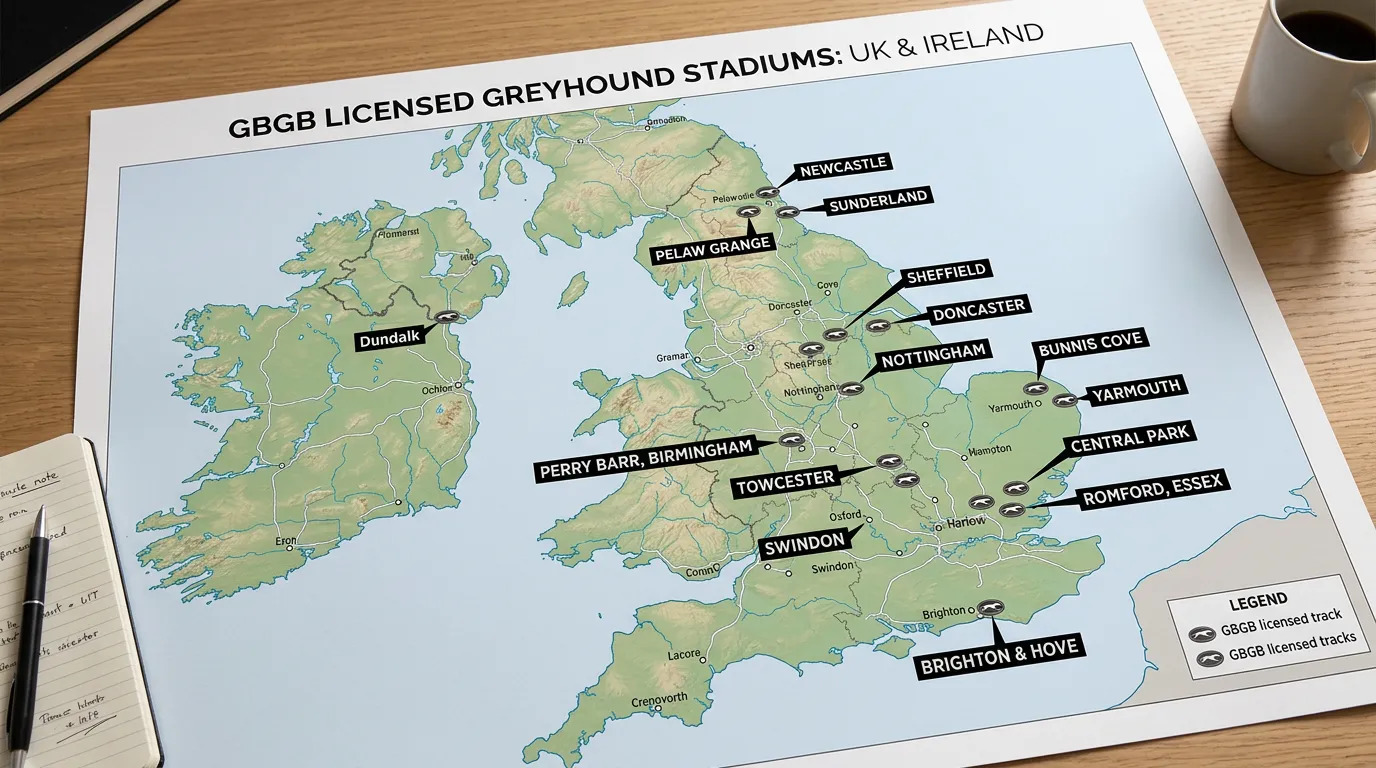
The United Kingdom currently has 18 GBGB-licensed stadiums where regulated greyhound racing takes place. This number has declined significantly from historical peaks—decades ago, the country supported many more tracks, with London alone hosting numerous venues that have since closed. Today’s surviving tracks represent the commercially viable core of British greyhound racing.
Geographic distribution clusters tracks in certain regions. England holds the majority, with concentrations around major urban areas. Scotland and Wales each have a single licensed track—Kinsley in Scotland and Valley in Wales, though Valley faces closure under forthcoming legislation. Northern Ireland operates under separate arrangements. This distribution means travel distances vary significantly for trainers, affecting which dogs appear at which venues.
Circuit sizes range from compact to expansive. The smallest circuits measure around 380 metres or less; the largest exceed 450 metres. This variance affects racing significantly. Smaller circuits feature tighter bends where cornering ability matters more than raw speed. Larger circuits allow galloping dogs to extend their stride, favouring pure pace over bend-handling skill.
Run-up distances vary similarly. The run from traps to first bend determines how much early positioning happens before dogs must navigate their first corner. Short run-ups compress the battle for position; long run-ups allow more sorting out before the first bend. This single measurement affects trap bias significantly—inside traps matter less when dogs have ample room to establish position.
Surface types and lure systems differ between tracks. Most UK tracks use sand-based surfaces, but composition varies. Some tracks produce faster times than others at equivalent distances, reflecting surface speed. Lure types—inside or outside rail systems, different hare styles—affect how dogs chase and corner. Dogs accustomed to one system sometimes need adjustment time when encountering another.
Major venues attract the best dogs and the biggest competitions. Towcester, Nottingham, Hove, and others host prestigious events that draw elite runners. Smaller venues focus on regular BAGS racing that services the betting market without necessarily featuring top-class fields. This hierarchy means form quality varies between venues—winning at a major track against strong opposition indicates more than winning at a quieter venue against moderate competition. Racing calendars differ between tracks too. Some venues race multiple times weekly; others host meetings less frequently. The volume of racing affects form currency—a dog with recent experience at a busy track arrives race-fit, while one from a venue with sparser scheduling might need a run to sharpen. These operational differences add another dimension to cross-track form comparison.
Where Romford Fits
Romford operates a 350-metre circuit—towards the smaller end of the UK spectrum. This compact size means bends come quickly and frequently throughout races. Dogs must corner well to succeed; pure galloping speed matters less than at larger circuits where dogs can extend their stride through longer straights.
The 67-metre run to the first bend at Romford compresses early positioning significantly. Dogs have limited distance to establish racing room before the first corner, making trap draw particularly influential. Inside traps carry advantage because dogs can secure rail position quickly; wide draws face the challenge of covering extra ground or finding themselves boxed out as the field converges.
Romford uses an Outside Swaffham hare system, with the lure running on the outside rail. Dogs chase around the outside, which affects racing line and cornering dynamics. Tracks with inside lures produce different running patterns; dogs moving between systems sometimes need races to adjust.
Similar tracks to Romford include other compact circuits where bend-handling and early pace matter disproportionately. Form from tracks with comparable geometry—similar circumference, similar run-up distances—translates more reliably than form from larger venues. When a dog shows good form at a 380-metre circuit and then appears at Romford, the transition is less dramatic than when moving from a 460-metre galloping track.
Romford’s position as London’s only licensed track gives it unique significance. Following Crayford’s closure, all London-area greyhound racing concentrates here. This concentration affects competition quality—dogs that might previously have spread across multiple venues now compete at Romford, potentially raising standards across grades. The track sees good quality racing precisely because it serves a large catchment area with no alternative. The post-2019 renovation further distinguishes modern Romford from its historical configuration. Times and form from before the renovation don’t translate directly to current expectations. Punters analysing Romford form should focus on post-renovation performances when available, treating the modernised track as effectively a different venue from its earlier incarnation despite sharing the same location and name.
Form Transfer Between Tracks
Not all form transfers equally. Dogs moving between tracks face varying adjustment challenges depending on how different the venues are. Understanding which form carries weight at Romford—and which requires discounting—improves assessment accuracy.
Form from similarly-sized tight tracks transfers most reliably. A dog showing strong bend-handling at another compact circuit should handle Romford’s turns similarly. Early-pace form also carries across—dogs that consistently lead to the first bend at one track tend to show similar traits elsewhere. These fundamental characteristics—cornering, early speed, racing style—persist across venues.
Form from larger galloping tracks requires caution. A dog that won impressively at a 450-metre circuit might lack the cornering ability to reproduce that performance at Romford. Their wide-running style might cost extra ground at every turn. Conversely, their stamina advantage might matter less when races take fewer strides to complete. Times from big tracks don’t convert directly to expected times at smaller venues.
Distance equivalences also need consideration. Standard distances vary between tracks—one venue’s 480 metres might be another’s 475 metres. A dog with proven form at 480 metres elsewhere might face exactly that distance at one track but something slightly different at another. Marginal distance differences sometimes matter more than they appear, particularly for dogs with strong distance preferences.
Track specialists exist—dogs that consistently perform best at particular venues. Their track-specific knowledge and suitability compounds over repeated visits. When these dogs travel elsewhere, their specialist advantages disappear. Conversely, when dogs arrive at Romford without prior course experience, they face a learning curve that experienced Romford runners don’t share.
Adjusting form for track differences is inexact but necessary. The question becomes: does this dog’s style suit Romford’s demands? Front-runners with early pace and good cornering transfer well. Wide-running gallopers with limited early speed transfer poorly. Identifying running style from form comments helps predict how dogs will handle the transition.
Selecting Tracks to Follow
No punter can follow all 18 licensed tracks with equal attention. Selecting which venues to focus on determines where your knowledge deepens and where it remains shallow.
Specialisation offers advantages. Following one or two tracks closely builds intimate knowledge—trainer patterns, kennel form, trap biases, surface quirks. This accumulated understanding often exceeds what casual observers possess, creating edge when others lack the same depth. A Romford specialist knows subtleties that someone betting randomly across all UK tracks cannot match.
Coverage has its own merits. Following multiple tracks surfaces opportunities that single-track specialists miss. When a dog with good form elsewhere appears at a venue you follow, you can assess the transition while those focused solely on one track might miss the visitor’s quality. Breadth trades depth for scope.
Practical constraints often determine focus. Live viewing, if available, naturally concentrates on accessible venues. Betting preferences might favour tracks with timing that suits your schedule. Some punters prefer evening racing; others focus on BAGS meetings that fit around work. These constraints aren’t weaknesses—they’re rational narrowing of what would otherwise be an unmanageable information load.
For those new to greyhound betting, starting with one track makes sense. Learn its characteristics thoroughly before expanding. Romford’s combination of quality racing, regular fixtures, and accessible coverage makes it a reasonable choice for anyone in the London area or seeking a well-documented venue to study. Master one venue first; then decide whether to specialise deeper or broaden coverage to additional tracks. The skills developed studying any single track—reading form, understanding trap bias, recognising trainer patterns—transfer when you eventually expand your focus.