
Best Greyhound Betting Sites – Bet on Greyhounds in 2026
Loading...
Understanding how to read a greyhound form guide separates informed bettors from those guessing at random. The numbers, abbreviations, and data points packed into a race card contain everything you need to assess each runner’s chances, but only if you know what to look for and how to interpret it. At Romford, where the track’s unique geometry affects how races unfold, form reading requires both general skills and track-specific knowledge.
The form guide is essentially a compressed history of each dog’s recent performances. Every number tells part of a story about pace, positioning, consistency, and class. Learning to decode this information transforms the race card from a confusing grid into a powerful analytical tool. The numbers tell the story, as experienced form readers like to say, but you need to understand the language.
This guide breaks down each component of the greyhound form guide, explains how to interpret the figures you will encounter, and provides practical guidance on applying this knowledge at Romford specifically. Whether you are new to the sport or looking to sharpen your existing skills, mastering form reading is the foundation on which all successful betting is built.
The Anatomy of a Race Card
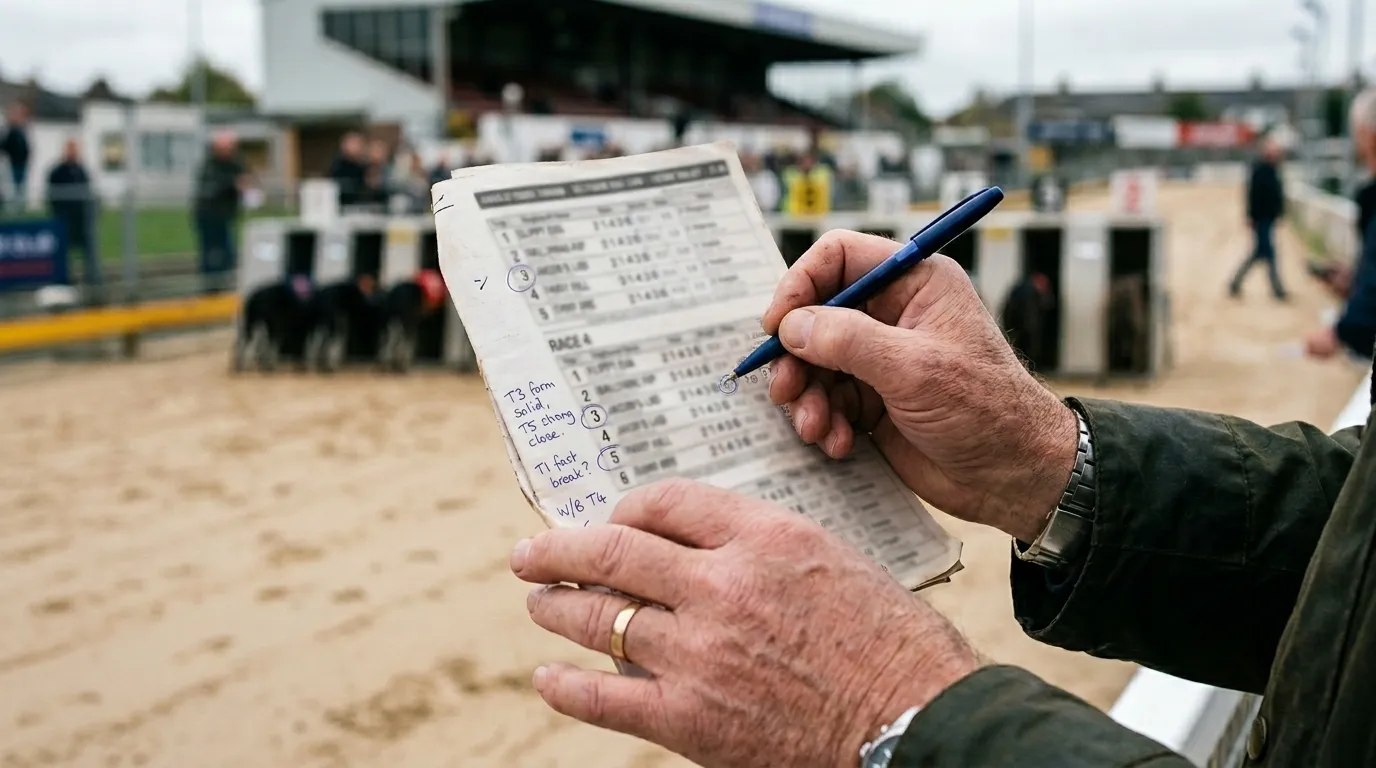
A greyhound race card presents a lot of information in a compact format, and knowing where to find each piece of data saves time and prevents confusion. Different providers layout their cards slightly differently, but the core information remains consistent across platforms.
At the top of each race entry, you will find basic details about the race itself: the race number, distance, grade, and scheduled time. The distance matters because dogs have preferred trips, and a sprinter entered in a staying race faces different challenges than when running over its optimal distance. The grade tells you the quality level, with A-grade races featuring the best dogs and lower letters representing lesser ability bands.
Each runner’s entry typically starts with the trap number and the colour of that trap. Trap 1 is red, Trap 2 blue, white for Trap 3, black for Trap 4, orange for Trap 5, and black and white stripes for Trap 6. These colours correspond to the jackets worn by the dogs, making visual identification easier both at the track and on screen. The trap number is fundamental to assessing each dog’s chances, as starting position significantly influences racing dynamics.
The dog’s name appears prominently, usually with the trainer’s name alongside. Some cards also show the owner, though this information is less relevant for form analysis. More important is the dog’s colour, sex, and age, which appear in abbreviated form. A typical notation might read “bkd” for a black dog or “wbd” for a white bitch, followed by the dog’s month and year of birth. Age matters because younger dogs are often still improving while older animals may be past their peak.
The form figures themselves appear as a string of numbers and letters representing recent race positions. We will examine these in detail shortly, but their visual prominence on the card reflects their importance. Below or beside the form string, you will usually find recent race times, distances, and sometimes the track where each performance took place. When assessing Romford form specifically, knowing whether a time was recorded at the same track carries more weight than performances elsewhere.
Sectional times, which measure a dog’s pace at different stages of the race, appear on more detailed cards. These figures, usually expressed in seconds, reveal whether a dog leads early, finishes strongly, or maintains consistent pace throughout. The weight is listed in kilograms or pounds, showing the dog’s racing weight at its most recent run. Some cards show weight change from previous runs, a useful indicator of condition.
Additional information might include the dog’s breeding, previous trainer history, or comments from recent races. Comments like “ld” for led, “crd” for crowded, or “ck” for checked provide context that bare finishing positions cannot convey. Understanding these abbreviations, covered later in this guide, adds depth to your form analysis.
Reading Form Figures
Form figures are the compressed record of recent race finishes, displayed as a string of numbers and occasionally letters. A typical form line might read “312541” representing the dog’s last six race results, read from left to right with the most recent result last. Understanding what each position means and how to weight recent versus older form is central to race card analysis.
The numbers 1 through 6 represent finishing positions in six-dog races. A “1” means the dog won, a “6” means it finished last. Simple enough on the surface, but the real skill lies in understanding context. A dog showing “654321” has been improving steadily, while “123456” suggests declining form. Neither tells the complete story without examining why those positions occurred.
Letters in the form string indicate something other than a standard finish. “F” denotes a fall, which happens occasionally and tells you the dog either stumbled or was brought down by another runner. This is different from “W” for withdrawn, meaning the dog did not start for various reasons. “T” represents a trial rather than a competitive race, and trial form should be treated differently as the pressure and positioning differ from race conditions.
How many recent runs should you prioritise? The standard approach is to weight the most recent two or three performances most heavily, while using older form to establish patterns. A dog that consistently finishes second or third is more predictable than one whose form reads “165214” with no clear pattern. Consistency has value in betting, as predictable runners are easier to assess and often represent better betting propositions.
According to Timeform, which provides racing data and analysis, the dog leading at the first bend wins approximately 35% of the time. This statistic shapes how you interpret form figures. A dog consistently showing early positions in race comments but fading to finish fourth or fifth might be unsuited to races where early pace gets swamped, while the same dog in a race lacking early speed could dominate.
Track form deserves special attention. A dog showing “111” at Central Park does not necessarily replicate that form at Romford. Track dimensions, surface characteristics, and run-up distances all affect performance. When assessing runners at Romford specifically, prioritise form achieved at the same track. If course form is limited, look for performances at tracks with similar characteristics, though this requires knowing how different circuits compare.
Distance form provides another layer of analysis. A sprinter winning over 225 metres might struggle when stepped up to 575 metres, while staying types often need the longer trip to show their best. The form line does not always reveal distance, so cross-referencing with detailed past performances ensures you are comparing like with like.
Finally, look beyond bare finishing positions to the margins involved. Winning by five lengths suggests dominance, while a short-head victory indicates a much closer contest. Similarly, a sixth-place finish beaten by ten lengths tells a different story than beaten by a neck after trouble in running. The form figures are your starting point, but the full picture requires deeper investigation.
Sectional Times Explained
Sectional times break down a dog’s race into measurable segments, revealing how it distributes effort across the distance. Where finishing times tell you how fast a dog completed the race, sectional times show you how that time was achieved. This distinction matters because two dogs posting identical winning times might race in completely different styles.
The most common sectional division is into early pace and finishing pace. The split typically occurs at the first or second bend, depending on the distance and track. At Romford, with its 67-metre run to the first bend on standard distances, early pace measures how quickly a dog exits the traps and reaches the turn. This is crucial at this track because the relatively short run-up means dogs need to break sharply or risk being caught in traffic.
A fast early sectional indicates a dog that leads or races prominently from the start. These dogs often win by controlling the race, dictating pace, and avoiding trouble. However, fast early pace sometimes comes at the cost of finishing speed, with leaders tiring in the closing stages. Identifying dogs that show both quick sectionals early and late represents the ideal, but such animals tend to be short-priced favourites.
Dogs with slower early sectionals but quicker finishing times are closers or late runners. They need racing room to pick off tiring leaders, which means they are more dependent on how the race unfolds. A closer in a race full of early pace may find gaps opening, while the same dog in a steadily-run race might never get the opportunity to use its finishing kick. Reading sectionals helps you anticipate these scenarios.
Comparing sectionals across different races requires accounting for track conditions. A fast time on a good surface does not equate to the same performance on a heavy track. Similarly, strong headwinds or adverse weather affect sectionals inconsistently, sometimes penalising early pace more than finishing speed. When possible, compare sectional times from races run in similar conditions.
At Romford, the 67-metre run to the first bend creates specific dynamics. Dogs with quick early sectionals from trap positions nearer the rail often gain a decisive advantage, as they establish position before the first bend crowds form. The outside traps need to be especially quick early to avoid being squeezed wide. Analysing sectional times alongside trap draw provides a more complete picture than either factor alone.
The practical application of sectional analysis involves identifying mismatches. If one dog in a race consistently shows the fastest early pace but has been racing from poor trap draws, a switch to the inside may see improved results. Conversely, a strong finisher drawn wide in a race full of early pace might find the perfect scenario for a late surge. Sectionals do not predict outcomes with certainty, but they help you understand how races are likely to unfold and where value might lie.
Some race cards present calculated pace figures rather than raw sectional times. These adjusted ratings attempt to account for track conditions and race dynamics, providing a standardised comparison tool. Whether using raw times or rated figures, the underlying principle remains the same: understanding pace distribution reveals more than finishing times alone.
What Weight Changes Mean
A dog’s racing weight appears on most form guides, usually expressed in kilograms. More interesting than the absolute figure is how weight changes between races, as these fluctuations can indicate condition, fitness, and readiness to perform. Like human athletes, greyhounds race best within an optimal weight range, and deviations can signal improvement or decline.
Weight gain between races sometimes suggests a dog has been well fed and rested, potentially indicating the trainer has them primed for a good performance. However, excessive gain might mean the dog has done little training work and could be underprepared. The context matters: a kilogram increase after a two-week break is different from the same gain between races run days apart.
Weight loss can indicate either sharpening fitness or potential concerns. A dog losing half a kilogram after a busy racing schedule might simply be racing fit, muscle replacing any excess condition. Larger weight drops, particularly if the dog looks visibly leaner at the track, could suggest health issues or overwork. Again, patterns over time prove more reliable than single-race changes.
The GBGB requires dogs to be weighed before racing, and these weights must fall within acceptable ranges. A dog significantly outside its registered racing weight might be withdrawn, ensuring welfare standards are maintained. From a betting perspective, checking that a dog’s weight matches its recent racing pattern helps identify when something might be amiss.
Gender affects weight interpretation. Dogs typically weigh more than bitches of equivalent racing ability, and each sex has its own weight norms. A 32kg dog is lighter than average for its gender, while a 28kg bitch might be on the heavier side. Comparing weights within gender categories provides more meaningful analysis than treating all runners identically.
Some trainers are known to manipulate weight for perceived advantage, though the effectiveness of this practice is debated. What is less controversial is that consistent weights across races indicate stable condition, which is generally positive for predictability. A dog racing at 30.5kg, 30.6kg, and 30.4kg across three runs is showing the steadiness that suggests reliable form, while wild fluctuations raise questions about preparation or health.
Combining weight data with other form indicators strengthens your analysis. A dog showing improving form while maintaining consistent weight is more trustworthy than one whose improvement coincides with erratic weight changes. Neither guarantees future performance, but stacking factors in your favour is what form reading is ultimately about.
Grade Context in Form Reading
The grading system places dogs into ability bands, with A-grade representing the highest standard and lower letters indicating progressively weaker competition. Understanding how grades affect form interpretation is essential because a dog’s recent results tell different stories depending on the grade in which they were achieved. As Mark Bird, CEO of GBGB, has noted, “Proper regulation is the best approach to safeguarding the welfare of racing greyhounds, as well as maintaining the sport’s integrity and future prosperity.” This regulatory framework, including the grading system, ensures competitive racing while maintaining welfare standards.
When a dog is raised in grade after winning or performing well, it faces stronger opposition in its next race. The form figures might look impressive, but those performances came against inferior animals. A dog showing “111” in D-grade is an established winner at that level, but stepping up to C-grade means facing faster, more experienced competition. The same principle works in reverse: a dog dropped in grade after poor results now faces weaker opponents and may improve.
Form at the same grade carries more weight than form across different grades. If you are assessing two dogs in a C-grade race, and one has established C-grade form while the other is stepping up from D-grade, the established form is more reliable even if the stepping-up dog has won its last three races. The newcomer remains unproven at the higher level.
Trainer patterns around grade changes can be revealing. Some trainers are skilled at placing dogs where they have the best chance, and noticing when a kennels regularly succeeds with freshly dropped dogs suggests tactical racing. Others might push dogs up too quickly after a win, leading to immediate reversals. Over time, observing these patterns adds another dimension to form analysis.
Grade inflation and deflation also occur across the calendar. Early in the year, dogs returning from breaks might be racing below their eventual level as they regain fitness. Late in the season, end-of-career dogs sometimes drop through the grades. Knowing where you are in the racing year helps contextualise grade-related form trends.
Open races, which sit outside the grading structure, attract top dogs regardless of grade. A dog stepping from graded racing into an open event faces a step up in quality that grades alone do not capture. Similarly, handicap events, where dogs receive varying starts based on perceived ability, complicate direct comparisons with standard graded form.
The practical application involves asking: did this dog achieve its form against appropriate opposition, and does today’s race represent a similar test? A dog with glowing form from weak races may be a false favourite, while one whose moderate figures came against tough competition might be undervalued. Grade context often separates shrewd form readers from those looking only at numbers.
Putting It All Together
Theory only becomes useful when applied to real race cards, so let us walk through the form analysis process for a hypothetical Romford race. The method applies regardless of which specific dogs are running; the thought process is what matters.
Consider a C-grade 400-metre race with six runners. Your first task is scanning each dog’s form string for immediate patterns. You spot one showing “112133” suggesting consistent performance at this level. Another shows “354111” indicating recent improvement. A third has “666541” which looks like a dog finding its feet after a poor spell. Each pattern tells a different story before you even examine the details.
Next, check recent times. The consistent dog has been running 24.0 to 24.2 seconds over the distance, reliable but not spectacular. The improving dog clocked 23.8 seconds in its most recent win, the fastest in the field. The recovering dog showed 24.6 seconds recently but was recording 24.1 before its poor run. These times, all from Romford, suggest the improving dog has the speed advantage.
Now consider trap draws. The improving dog is in Trap 6, the outside position. Its recent sectional times show fast early pace, but from Trap 6 at Romford with its 67-metre run-up, even quick dogs can get shuffled back if they cannot hold their line on the first bend. The consistent dog is in Trap 2, near the rail, with sectionals showing moderate early pace but strong finishing. The recovering dog is in Trap 1, the prime rail position, but its sectionals suggest it needs to lead to show its best.
Weight checks reveal the improving dog has gained a kilogram since its last win, possibly indicating peak condition or possibly suggesting it peaked last time. The consistent dog is within 0.2kg of its recent weights. The recovering dog has lost 0.4kg since its poor runs, potentially sharpening up.
The grade context shows the consistent dog has been racing at C-grade for two months, while the improving dog just won a D-grade race and is stepping up. That 23.8 seconds is impressive, but it came against inferior opposition. The recovering dog has previous C-grade wins, suggesting it has ability to compete here when right.
Combining these factors, the market favourite is likely the improving dog based on its recent times, but the trap draw and grade step create doubt. The consistent dog offers reliability from a better trap. The recovering dog presents a value case if its form is returning, particularly from the prime rail draw. None of this guarantees the outcome, but you now have a reasoned view rather than a guess.
This process, repeated for each race, builds form reading skills over time. Some races present clearer pictures than others, and learning when to bet confidently versus when to step back is part of the journey. The more races you analyse, the quicker the process becomes and the more patterns you recognise.
Common Mistakes to Avoid
Even experienced form readers fall into traps that undermine their analysis. Recognising these common errors helps you avoid repeating them and improves the quality of your race assessments.
Overweighting a single run is perhaps the most frequent mistake. A dog wins impressively, and suddenly the market prices it as near certainty for its next race. But one performance, however good, represents just one data point. The form line “641111” looks weaker than “211111” precisely because that early inconsistency suggests the dog is capable of poor runs. Treating any single performance as definitive, whether positive or negative, leads to false confidence.
Ignoring track changes trips up many punters. A dog with excellent form at one track does not automatically transfer that form elsewhere. Different circuits have different dimensions, surfaces, and characteristics. A dog dominating at a track with a long run-up might struggle at Romford’s 67-metre setup. Always discount form from dissimilar tracks and prioritise performances at the venue where today’s race is run.
Misreading sectional times causes problems when people treat fast early splits as universally positive or slow early pace as always negative. The reality is that races unfold differently depending on the competition. A closer in a slow-paced race never gets the opportunity to use its finishing kick, while an early pace specialist in a fast-run race might set the pace and tire. Sectionals only become valuable when you consider how the race is likely to develop.
Failing to account for race conditions produces inaccurate comparisons. Comparing times from different days without considering track conditions, weather, and going treats fundamentally different performances as equivalent. A dog running 24.0 on heavy going might be superior to one clocking 23.8 on a fast surface. Conditions matter, and good form readers adjust for them.
Chasing losses often masquerades as form analysis. After a few losing bets, the temptation grows to back the next “obvious” winner at short odds to recover. This leads to forcing bets on races that do not warrant confidence, ignoring doubt signals that more careful analysis would identify. Discipline in stepping back from poor value situations protects against this trap.
Finally, analysis paralysis can become a problem. Form reading provides useful input, but no amount of analysis guarantees outcomes. Dogs are living animals, and racing involves genuine uncertainty. At some point, you must accept that your analysis is sufficient and commit to a position, or decide that the race is too unclear and move on. Endless review without conclusion is not form reading; it is procrastination.